


 Children 0-16
 Youth 17-24
 Students
 Accessibility
 Luggage
 Animals
 Tram
Tram
Nokia
Winter season 2026-2027
The bus route network in Nokia has been revamped because the service no longer meets the needs of the city’s growing population or changing travel patterns. The new route network aims to address the following challenges:
- Full buses and longer travel times: Service will be expanded in areas where passenger numbers are growing.
- Poorly coordinated transfers: Direct connections to Tampere every day, including from South Nokia. New routes will improve the efficiency of transfer connections.
- Cost-effectiveness: More trips will be added in areas where travel is growing and reduced where passenger numbers are low.
Routes in Nokia for 2026-2027
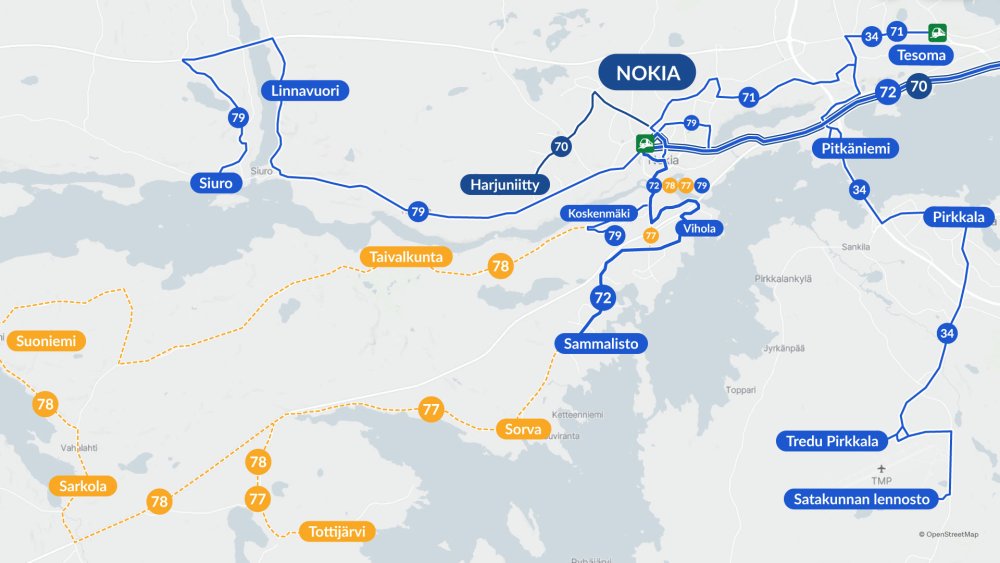
Harjuniitty – Taka-Lauttala – Nokia – Maatiala – Hyhky - Pispala – Pyynikintori - Keskustori
List of roads: Urpolankatu – Taka-Lauttalankatu – Pinsiöntie – Rautatienkatu – Pinsiöntie – Nokian valtatie – Valtatie 12 – Pispalan valtatie – Pirkankatu – Hämeenkatu - Keskustori
Service hours
- On weekdays between 5:00 and 00:00 (on Fridays until 3:00)
- On Saturdays between 4:00 and 3:00
- On Sundays between 4:00 and 00:00
The route operates twice per hour on each direction, in the early mornings and late evenings once per hour
Nokia - Kankaantaka - Välimaa - Kalkku - Tesoma
List of roads: Nokian valtatie - Souranderintie - Maununkatu - Härkitie - Pinsiöntie - Rautatienkatu - Kankaantaankatu - Ilkantie - Kankaantaankatu - Vihnuskatu - Kalkuntie - Pitkäniemenkatu - Ristaniitynkatu - Kalkun kehätie - Tesomankatu
Service hours
- On weekdays between 5:00 and 21:00
- On Saturdays between 8:00 and 21:00
- On Sundays between 10:00 and 20:00
The route runs hourly on both directions. Additionally, the route has school turns for school days of primary and middle schools for which the timetables will be fitted to the needs of schoolchildren.
Sammalisto – Tervasuo – Sotka – Kattilainen – Ketolanmäki – Tyrkkölä – Vihola – Pirkkalaistori - Nokia – Kennonnokka – Valtatie 12 – Hyhky – Pispala – Pyynikintori - Keskustori
List of roads: Sorvantie – Ketolanmäenkatu – Räikäntie – Päivärinteentie – Pyhäjärventie – Viholankatu - Nuijamiestentie – Emäkoskentie – Pirkkalaistie – Härkitie – Maununkatu – Souranderintie - Rautatienkatu – Pinsiöntie – Nokian valtatie – Valtatie 12 – Pispalan valtatie – Pirkankatu – Hämeenkatu – Keskustori
Service hours
- On weekdays between 5:00 and 22:00
- On Saturdays between 6:00 and 22:00
- On Sundays between 9:00 and 21:00
The route operates twice per hour on each direction, in the early mornings and late evenings once per hour
Tottijärvi - Sorva - Sammalisto - Tervasuo - Sotka - Kattilainen - Ketolanmäki - Pirkkalaistori - Nokia
List of roads: Tottijärventie - Sorvantie - Ketolanmäenkatu - Kehontie - Emäkoskentie - Pirkkalaistie - Härkitie - Nokian valtatie - Vihnuskatu - Kankaantaankatu - Ilkantie - Kankaantaankatu - Rautatienkatu
77x
Tottijärvi - Valtatie 12 - Ketolanmäki - Nokia
List of roads: Tottijärventie - Turuntie - Emäkoskentie - Pirkkalaistie - Härkitie - Maununkatu - Souranderintie - Rautatienkatu
Service hours
The route runs hourly on school days of primary and middle schools between the hours of 7:00 and 10:00 and 12:00 and 17:00. The timetables will be fitted to the needs of schoolchildren.
Tottijärvi - Sarkola - Vahalahti - Suoniemi - Ruolahti - Taivalkunta - Koskenmäki - Pirkkalaistori - Poutunpuisto - Nokia
Lists of roads: Tottijärventie - Turuntie - Jokivarrentie - Sarkolantie - Suoniementie - Sarkolantie - Taivalkunnantie - Emäkoskentie - Pirkkalaistie - Härkitie - Pinsiöntie - Rautatienkatu
Service hours
The route runs hourly on school days of primary and middle schools between the hours of 7:00 and 10:00 and 12:00 and 16:00. The timetables will be fitted to the needs of schoolchildren.
Siuron koulu- Saunakylä- Murhasaari - Linnavuori- Siuro- Korvola- Haavisto–Nokia – Kankaantaka – Pirkkalaistori – Koskenmäki
List of roads: Kuljuntie – Färmintie – Kyrösjärventie – Järvenjärventie – Valtatie 11 – Miharintie – Linnavuorentie – Vuorenhovintie – Miharintie – Siurontie – Siuron valtatie – Nokian valtatie – Rautatienkatu – Kankaantaankatu – Ilkantie – Kankaantaankatu – Vihnuskatu – Nokian valtatie – Härkitie – Pirkkalaistie – Emäkoskentie – Taivalkunnantie – Kuoppalankatu – Orelinkatu – Vaahterakatu
Service hours
- On weekdays between 5:00 and 22:00
- On Saturdays between 8:00 and 22:00
- On Sundays between 10:00 and 20:00
The service runs twice per hour on weekdays and hourly on weekends
 Passengers
The number of residents and passengers in Nokia has grown significantly. In 2024, there were 936,000 bus trips in Nokia, half of which were in the city's central area. Other areas with high passenger volumes include Harjuniitty, Myllyhaka, Kankaantaka, Vihola (Kartano area), Koskenmäki, Ketolanmäki, and Taka-Lauttala.
Buses in Tampere are increasingly full. Although trains complement service, travel time including transfers can be longer than a direct bus connection.
Passengers in smaller villages are mainly schoolchildren. These areas include Tottijärvi, Sorva, Sarkola, and Suoniemi.
 Finances
The average public subsidy needed for Nysse routes is 0,86€/boarding. Public subsidy needs on routes 70 and 72 between Nokia and Tampere have stayed below one euro. Other routes in Nokia have higher subsidy needs:
- 3 € for routes 71 Tesoma, 77 Tottijärvi ja 79 Siuro
- 4 € for route 73 Keho - Ilkan alue
- 8 € for route 74 Sammalisto
- 6 € for route76 Pirkkala
- 10 € for route 78 Sarkola
“Boarding” refers to every trip that begins (including transfers). “Public subsidy” refers to the funding proportion not covered by ticket sales.
The more people use the route, the less of the tax money paid by residents goes toward operating it.
The financial data covers the period from January to July 2024. The subsidy amount has been rounded to the nearest whole euro.
 Route changes
Route 70 does not change.
Route 71 movesfrom Kankaantaankatu to Rounionkatu. The route is otherwise unchanged.
Route 72 runs from Sammalisto to the Nokia train station via Vihola and the new Kartano residential area. The route continues to Tampere, as previously.
Route 77 changes only in the centre. Kankaantaka lies off the route.
The route portion between Sarkola and Tottijärvi is added to route 78. Express line 78x via Turuntie will be terminated.
A and B-route options will be removed from route 79. The route will always run between Siuro and the Nokia train station via Purso and Linnavuori. A new South-Nokia stretch has been added to the route, which runs to Koskenmäki via the Kankaantaankatu school campus.
 New stops in Nokia
Together with the changes to route 79, new stops are added to Järvenjärventie to serve the area's schoolchildren.
The stops:
 Discontinued routes
Routes 73, 74, and 76 are being discontinued due to low passenger numbers. The services will be replaced as follows:
- Ilkan alue: route71
- Kankaantaka: route 79
- Vihola and Ketolanmäki: route 72
- Koskenmäki: route 79
Connections to Pitkäniemi and Pirkkala will, in the future, require a transfer via Tesoma or the Tampere city centre.
 Bus fleet
The poor condition of roads in rural areas has caused several traffic accidents involving buses. According to the Inner Finland Economic Development Centre, funding for road improvements or better maintenance is not available.
The safety of school transportation can be improved with vehicles suitable for village roads. Routes 77 and 78 will make use of minibuses, operated by Länsilinjat Oy.
Decisionmaking
The new route network will take effect for the 2026–2027 winter season, as the operating contracts for routes 74–79 expire in the summer of 2026.
Nokia’s first route plan was published on 15 April 2025. The plan was revised based on feedback and discussions with the City of Nokia.
The decision-making process proceeded as follows:
- Routes and service level: 23 April 2025
- Tendering for transport services: 21 May 2025
- Transportation contract: 27 August 2025
Länsilinjat Oy won the competitive bidding for the operation of routes 77 and 78. The contract period is 3 August 2026–5 August 2029. The contract may be extended by two one-year (1+1) option periods. More information from Nysse bulletin.
 More information